
This blog opened with a post called "Coming Soon: What to Expect on Our Travel Platform". It promised guides, an itinerary builder, a trip designer, and flights, cruises, stays and experiences all under one roof. It was, if we're being honest with each other, a list of intentions written by someone who had not yet had to build any of it.
AdventureLab went live at adventurelab.ai on 15 July 2026. So here's the inventory: what you can do on the site today, what's still just a name in the menu, and what's next—in the order it's likely to arrive rather than the order that sounds most impressive.
Table of Contents
- Flights: Real Search, Real Airlines
- Experiences: 300,000 Things to Do
- Stays: See What a Neighbourhood Actually Costs
- Guides: Seventeen of Them, in Two Languages
- What's Next
- How This Is Funded
Flights: Real Search, Real Airlines
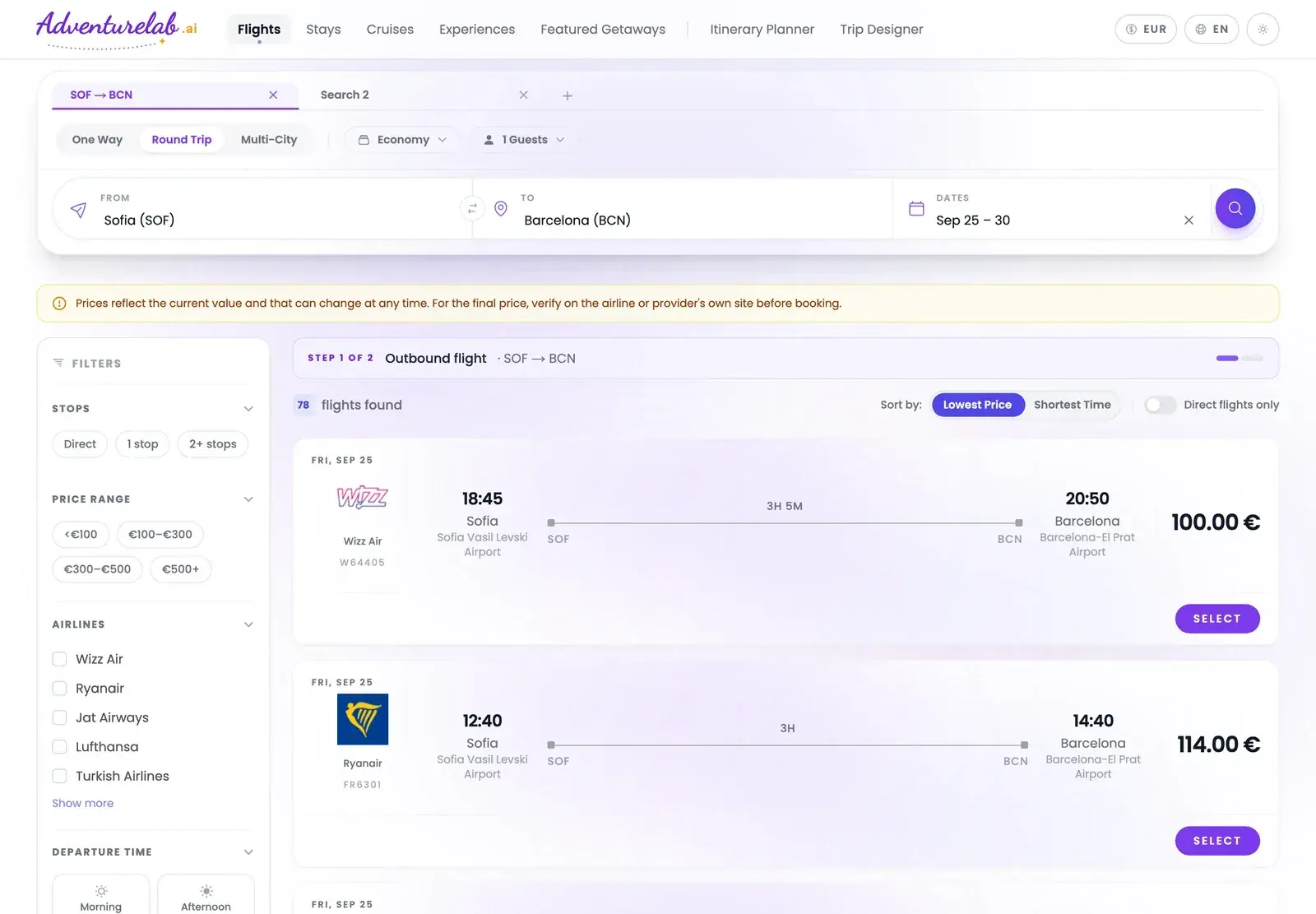
Flight search is live and it's real-time, across airlines. Type a route, get fares.
You can also keep up to five searches open at once, each in its own tab—Tuesday against Saturday, Barcelona against Valencia, one adult against two—and flip between them without losing the results you already have. Comparing options is most of what booking a flight actually is.
But the part worth making a point of isn't the search. It's where the search sends you.
Every flight result on AdventureLab links you to the official airline website to book. Not a reseller. Not a consolidator with a name you've never heard of and a support line that opens at 3 a.m. Bulgarian time. This is a deliberate stance, not a gap we haven't got round to filling. When a flight is cancelled, rebooked, or delayed into a different day entirely, the person who can actually fix it is the airline—and that gets dramatically harder when a third party sits between you and the ticket. There are no mystery service fees on the way through, either, because there's no middleman collecting them.
You give up a little convenience. You get back the ability to phone someone who can help.
Experiences: 300,000 Things to Do
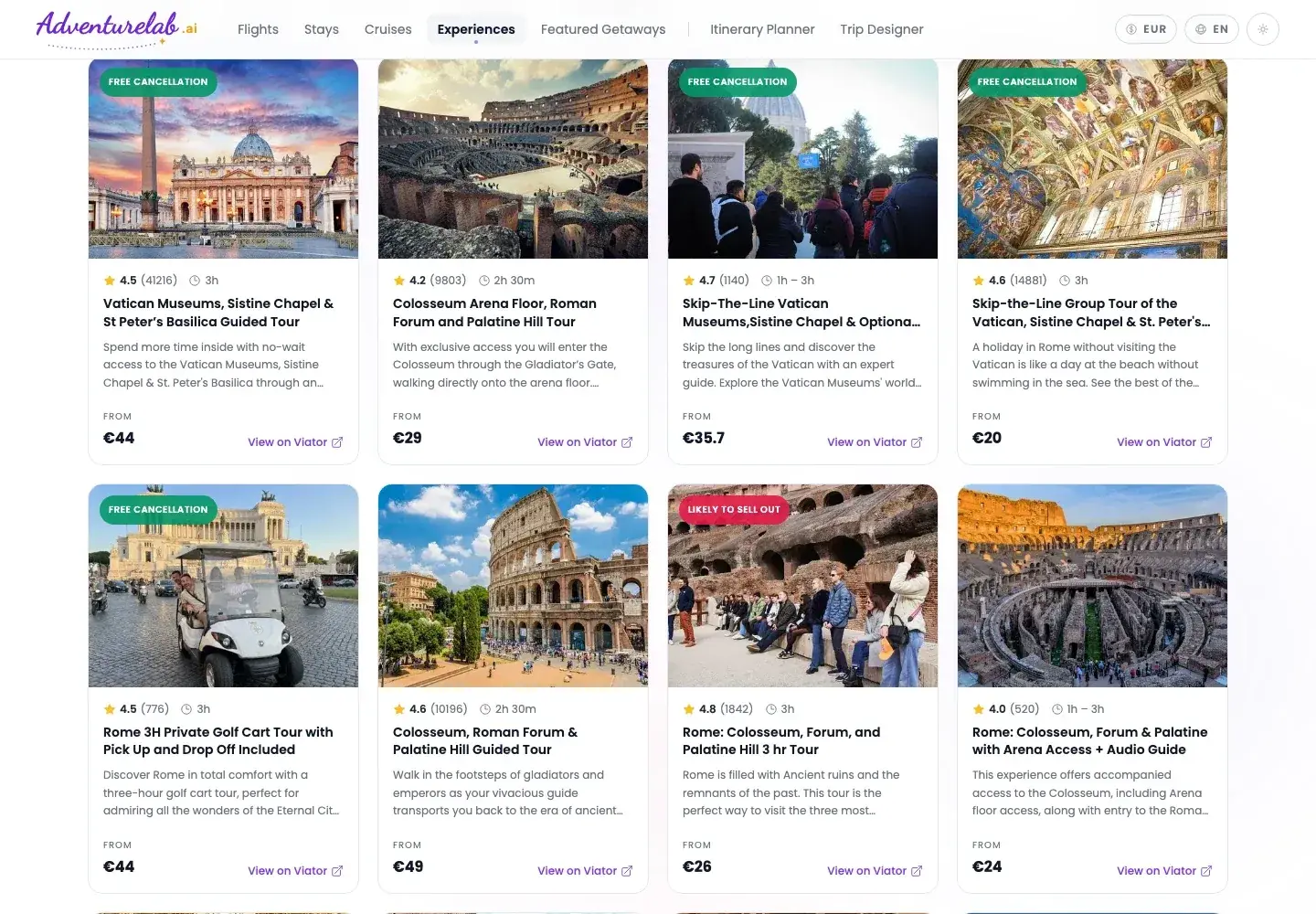
Experiences shipped on 27 July 2026: tours, tickets and activities across thousands of destinations. That's more than 300,000 of them, which is a number so large it stops meaning anything—so here's a concrete one instead. Type "Rome" and you get 8,231 experiences.
Each card gives you a photo, a star rating with the review count, the duration, and a "from" price in whatever currency you've selected—plus badges where they apply, like "Free cancellation" and "Likely to sell out". You can filter by category, price, rating, duration and free cancellation, and sort the results once you've narrowed them.
Booking happens on Viator. We hand you off with a "View on Viator" link, and yes, those are affiliate links—more on exactly what that means below.
Stays: See What a Neighbourhood Actually Costs
Stays went live on 18 August 2026. It's the newest thing here and the biggest.
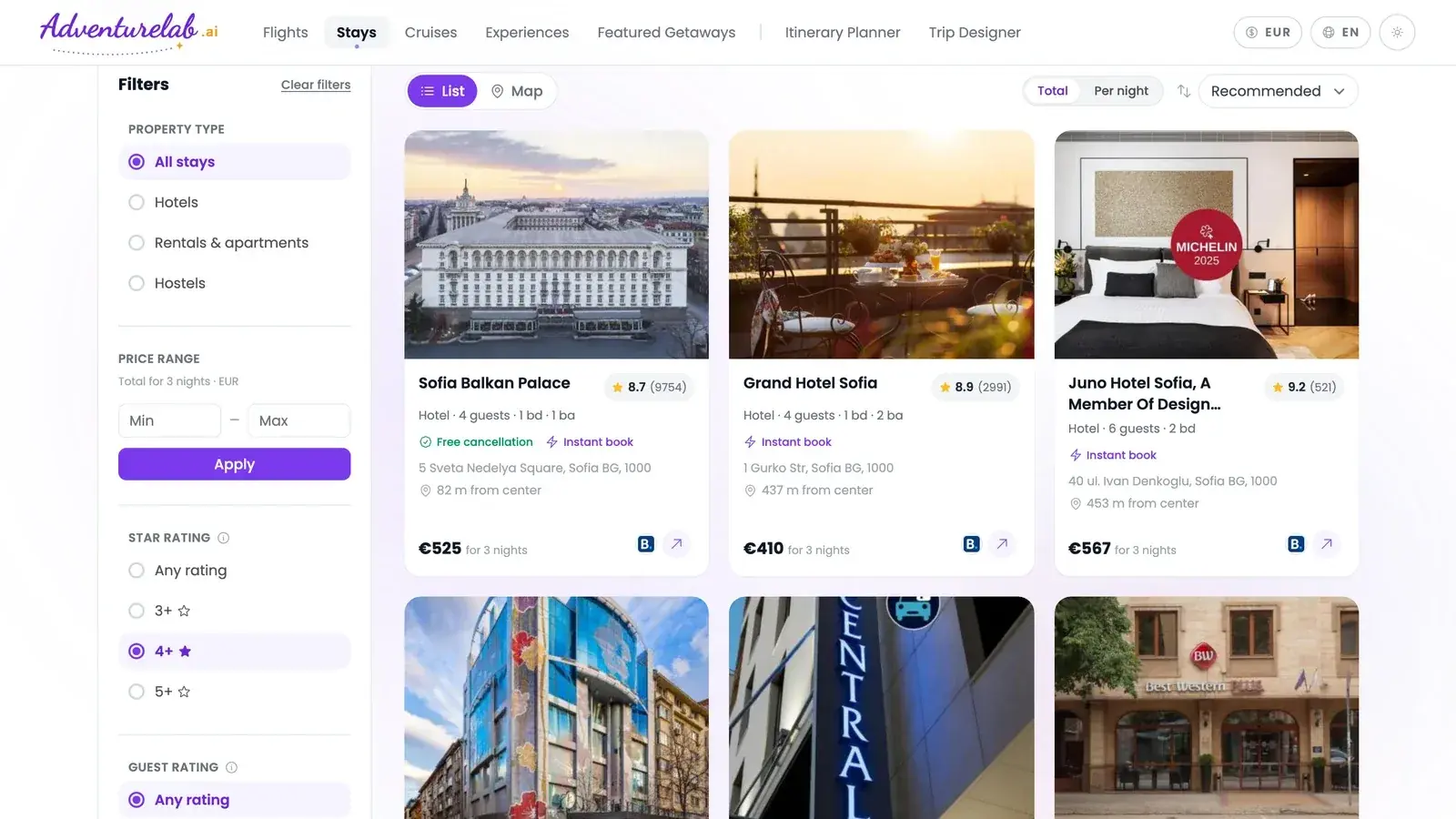
It's live accommodation search, and a single search covers Booking.com, Expedia, Vrbo and Hotels.com at once—instead of you opening four tabs and losing track of which one had the good cancellation policy. You can browse all stays, or narrow to hotels, rentals and apartments, or hostels.
Filters: price range, star rating, guest rating, minimum number of reviews, distance from the centre, free cancellation, instant book. Two of those deserve a closer look.
There's a total ⇄ per-night price toggle, and the price filter follows whichever unit you picked. Set a maximum of €150 while you're looking at per-night prices and you get stays under €150 a night. Switch to totals and it means totals. It should be obvious. It very often isn't, on sites much larger than this one.
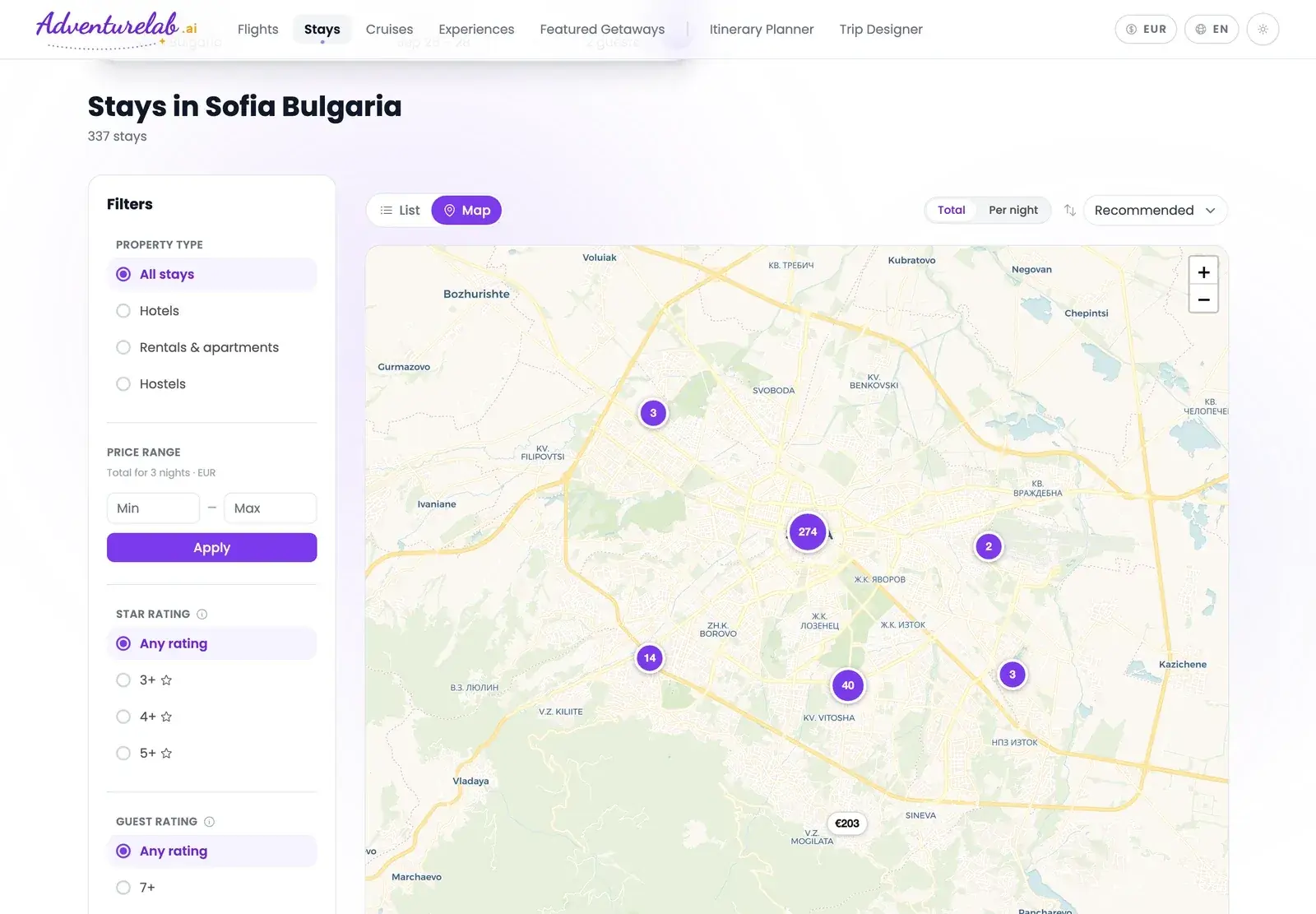
Then there's the map view, with live price pins sitting on the map itself. This is the feature I use most, because a list of prices tells you what a room costs and a map of prices tells you what a neighbourhood costs—which is the thing you actually needed to know before you fell in love with a listing forty minutes from anywhere. It shows every result, not just the page you're on. Where pins pile up too densely to read, they gather into a single count bubble; zoom in and they become individual prices again. Tap any card and you get a detail view with photos and the available offers.
It also isn't a static picture of the search you typed. Pan or zoom and a "Search this area" button re-runs the search over whatever you're now looking at, labelled with somewhere a human recognises—"Varna, Bulgaria"—and showing how wide a net you just cast. From a marker there's a "Search near this stay" too.
A worked example, Sofia, three nights, two guests: about 340 stays. Filter to five-star within a kilometre of the centre and you're down to six, with total prices from around €380. Those numbers move, of course—it's live inventory, not a brochure.
Sofia, Plovdiv and Bansko also have proper city pages, with written neighbourhood-by-neighbourhood guidance—who each area suits and what it trades off—sitting directly above the live listings.
Guides: Seventeen of Them, in Two Languages
The guides were the one thing that first post could honestly call available. There are seventeen now, covering three regions in depth rather than the whole planet thinly:
- Scotland — Scotland, Edinburgh, Glasgow, Stirling, Inverness, St Andrews and Shetland
- China — China, Beijing, Shanghai, Xi'an and Zhangjiajie
- Japan — Japan, Tokyo, Kyoto, Nara and Osaka
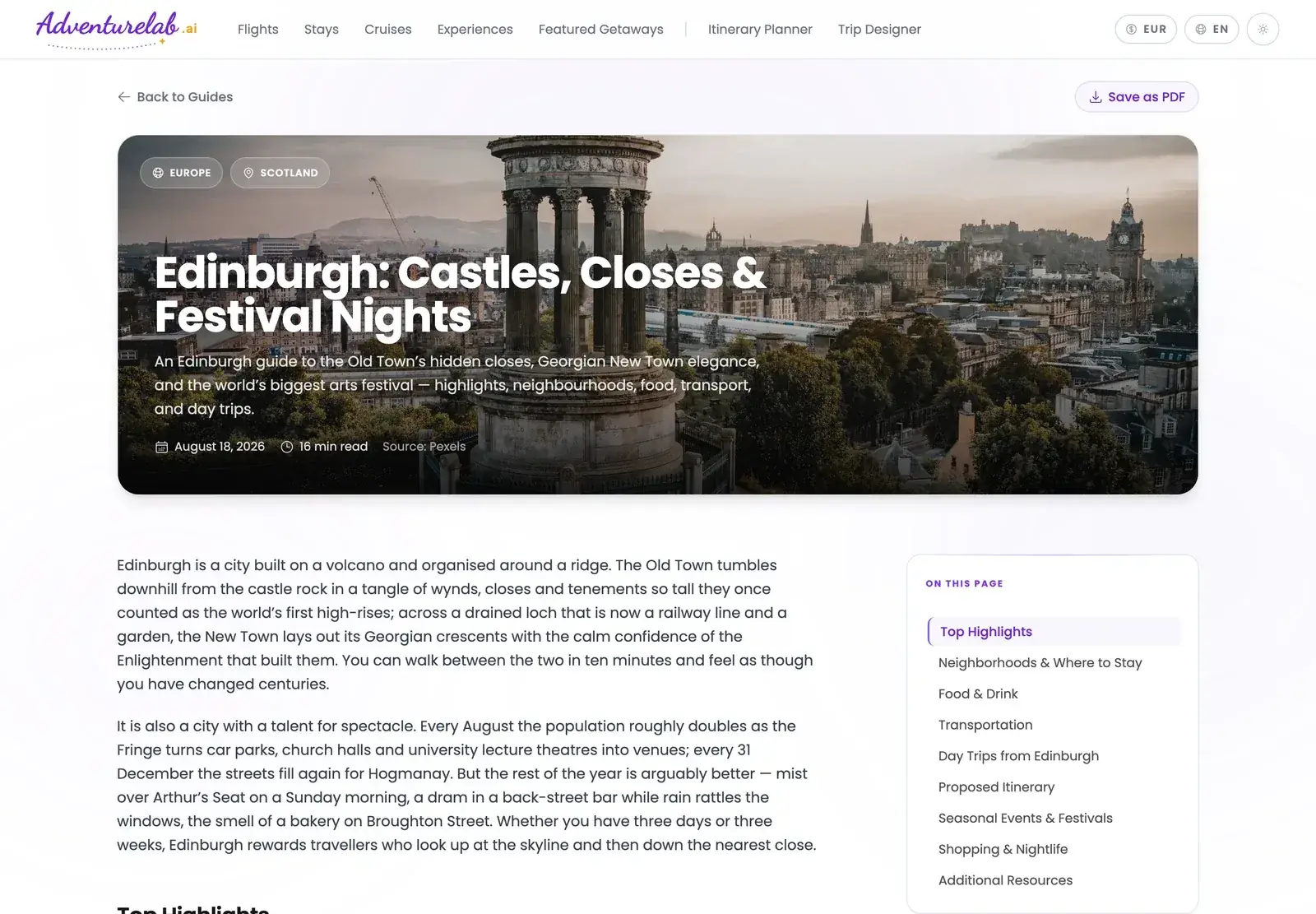
These are not listicles. Each one runs long—the Edinburgh guide is a sixteen-minute read—and follows the same structure so you learn where to look: top highlights, neighbourhoods and where to stay, food and drink, transport, day trips, a proposed itinerary, seasonal events and festivals, shopping and nightlife, and further resources, with a jump-to-section list at the top so you can skip straight to the part you need at the airport.
Every guide now has a "Save as PDF" button, for the flight or the train or wherever the signal isn't—or for the version you'd rather have printed and folded in a pocket.
And it works in the other direction too: the stays pages point back to the guides, so a page full of bookable rooms sits next to the written advice about which part of the city you actually want to wake up in.
Every single one exists in English and Bulgarian. Properly translated and edited, not run through a machine and published unread. That applies to the whole site, incidentally—every page, guide and post here is bilingual, and the Bulgarian version is a first-class citizen rather than a courtesy.
The smaller things
Also live, and worth a line each: the blog you're reading now, which is at fifty posts, every one of them in both English and Bulgarian, and filterable by tag; a real newsletter with double opt-in confirmation and spam protection; currency switching; and a light and dark theme.
What's Next
Cruises are next up, and the first version will be editorial: hand-picked itineraries and deep links to trusted cruise partners, rather than a convincing search box sitting on top of inventory we don't have.
Featured Getaways will keep a shortlist of destinations under quiet review in the background, and flag a route when it is genuinely cheap rather than merely labelled as on sale. Deal cards will bundle the flight, a suggested stay and things to do.
Accounts and "My Trips" come after that: sign in, save what you find, come back to it later. Right now everything you discover here lives in your browser history, which is a state of affairs I'd like to end.
The Itinerary Planner and Trip Designer are the flagship—the day-by-day plan where flights, stays and experiences finally converge, with "add to trip" buttons everywhere on the site.
Community comes further out, deliberately sequenced: shareable trip links and public profiles first, then discussion on shared trips, then collaborative group planning—with moderation and the ability to take your data with you or delete it there from the start.
And one wilder idea being kept warm: a theme-park day planner that builds your park day around ride wait times.
How This Is Funded
Straightforwardly: affiliate links.
When you book an experience on Viator, or a stay on one of the booking sites we search, after clicking through from here, AdventureLab earns a commission. It costs you nothing extra—the price is exactly the same as if you'd arrived there yourself—and it's what pays for the hosting and the hours.
Which is also why this site links out rather than taking your card. We don't process your payment and we don't hold your booking, so we're never sitting between you and the company that owes you a room or a seat. Given the choice between owning the checkout and being useful when something goes wrong, this seems like the right call.
That's the honest state of things, held up against that original list of promises. Rather less than the promises, in some places. Rather more careful, in others.
If you want somewhere to start, start with the guides—they're the deepest thing here, and the Edinburgh one will keep you busy for a while. If you'd rather be told when the next piece lands, the newsletter is the place to be; it's where cruises, getaways and eventually the planner will get announced first. No spam, no daily deal blasts, just news when there's actually news.
Thanks for being here early.